Resources · Journaling
Journaling gives you a simple place to put your thoughts, notice patterns, and build a daily reset routine. No perfect notebook or long routine required.
Journaling doesn't have to be complicated. You don't need a perfect notebook, a long routine, or a deep thought every time you open the page. At its simplest, journaling gives you a place to put what's on your mind. Some days that's one sentence. Other days it's a longer reflection. The value isn't in writing perfectly — it's in giving your thoughts somewhere to land instead of leaving them scattered.
The benefits, at a glance:
Most days move fast. Messages, decisions, conversations, and plans pile up before you've had a chance to look at any of them. Writing gives you a way to slow that down. When you journal, you take something that was floating around in your head and put it somewhere you can actually look at it. That one act often makes a thought easier to understand. You might notice what you've been avoiding, what keeps resurfacing, or what matters more than you'd realized. You're not trying to solve everything in one sitting. You're just giving yourself a place to start.
One entry doesn't look like much. But a month of them becomes a record of what you keep returning to — the situations that drain you, the moments you felt proud of, the habits you're trying to build, the small wins you'd otherwise forget. Read back later, your old entries also show you something harder to see in the moment: how your thinking has shifted, what used to matter that doesn't anymore, where you've actually grown. That's one of the quieter benefits of journaling. You stop only reacting to your life and start noticing it.
A reset doesn't need to take an hour. It can be a short moment where you pause and ask, "What do I need to write down?" That might be a morning check-in before things get busy, an evening note before you close the day, or a quick line right after something meaningful happens. The point isn't to build a routine that feels heavy. It's to keep a small practice you'll actually return to. (More on that in how to build a daily reset routine.)
The biggest reason people avoid journaling is the belief that they need something important to say. You don't. Start with a simple prompt:
A useful entry can be one honest sentence. If you want a softer entry point, reflecting on a quote is one of the easiest ways to start writing without facing a blank page.
If your routine feels complicated, you'll skip it. If it feels light, you'll come back. That's why short check-ins, quick reflections, and open writing tend to outlast elaborate systems. Keep the bar low enough that showing up is easy.
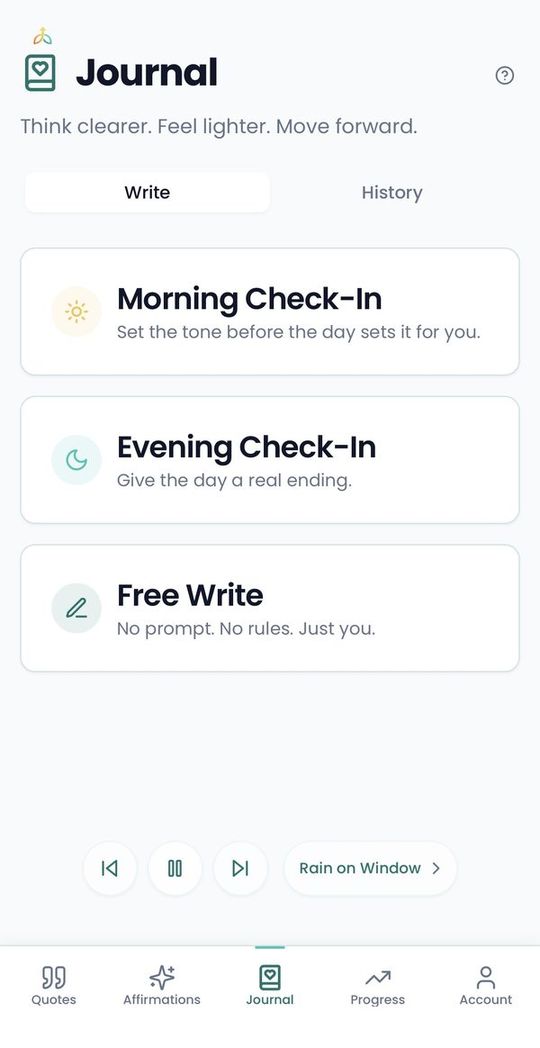
EVERLIFT gives you a simple place to write when you need somewhere to put your thoughts. Use Free Write for open journaling, Morning and Evening Check-Ins when you want a little structure, and quote reflections when a line lands and you want to capture why. Your entries and reflections stay together, so the habit has one home instead of five. New here? See what EVERLIFT is.
Download EVERLIFT on the App Store →
Start free and build the routine when you're ready.
Journaling can support clearer thinking, help you notice patterns over time, give you a small daily reset, and leave you a record you can return to. You don't need a long routine to get value from it.
Start with one prompt — "What's on my mind right now?" or "What do I want to remember from today?" A single honest sentence counts as an entry.
As long or as little as you want. A short daily check-in you'll actually return to beats a long routine you abandon.
Keep reading
What is EVERLIFT? · Reflecting on quotes · How to build a daily reset routine
 EVERLIFT