Resources · Affirmations
Affirmations are short reminders you return to. Learn the difference between built-in and personal affirmations, and how to write ones that actually sound like you.
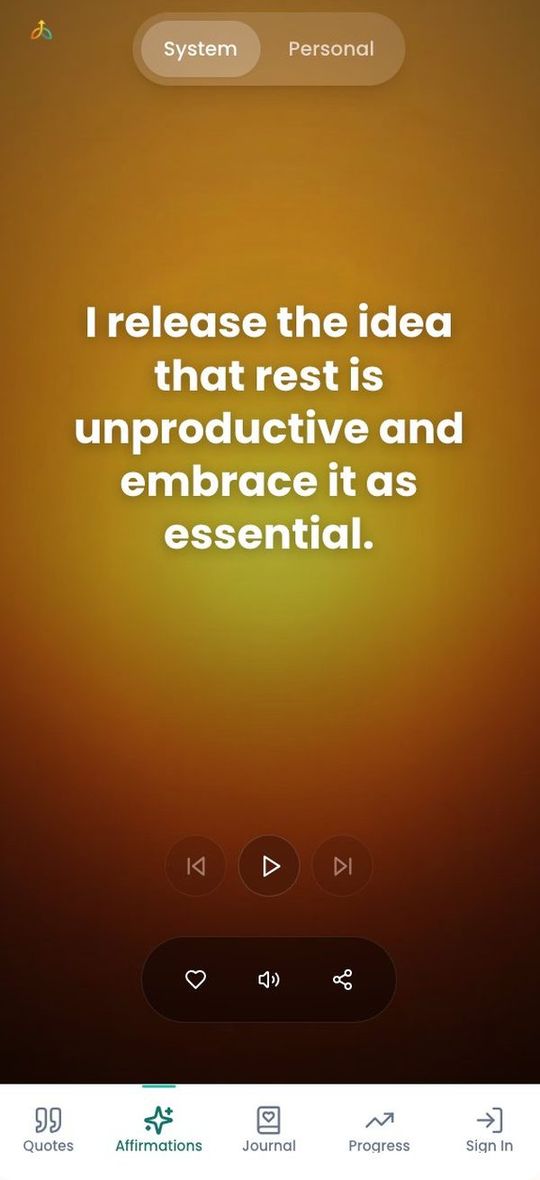
Affirmations are short statements you read or repeat as reminders. They help you focus on what you want to practice, how you want to show up, or what you want to remember when life gets busy. An affirmation doesn't need to be dramatic or sound like a slogan. It works best when it's honest enough that you'll actually use it.
A grounded affirmation isn't a guarantee or a shortcut, and it isn't pretending everything's fine. It's a reminder — a way to return to a thought or behavior you want to practice. And there's a catch most people miss: an affirmation only does something if you actually believe it. Saying words you don't mean is just noise. The point isn't the phrase — it's that you accept it as true about yourself. A few simple examples:
These are plain on purpose. Plain is what gets used — and what's easy to believe.
There are two useful kinds, and EVERLIFT is built around both.
Built-in affirmations are ready-made statements you can read when you need a reset and don't know what to say yet. Think of them as a starting point — a guide. Personal affirmations are the ones you write yourself, and they tend to carry more weight, because the power in an affirmation comes from the words you give yourself, not the ones handed to you.
A built-in affirmation might say: "I can move forward one step at a time." A personal version might say: "I can take care of today without trying to fix my whole life at once." The second one usually hits harder — because it sounds like you, and you're more likely to believe it.
Start with what you actually need to remember. Pull from a challenge you're facing, a quality you want to practice, or a reminder you keep forgetting. A simple structure helps:
For example: "I can pause before I react." "I choose the next honest step." "I'm practicing patience with myself." "I don't have to earn rest." "I'm allowed to start small." Keep the language direct. If it feels fake, rewrite it until it sounds like something you'd actually say out loud — and mean.
Affirmations are easier to use when they have a home — in the morning, before a hard conversation, during a short reset, or before bed. You don't need a long routine. You just need a place to return. Pairing one with a daily reset is an easy way to make it stick. And if a line you read elsewhere lands, the same instinct applies as with quotes: save what resonates and write why.
EVERLIFT gives you built-in affirmations for when you need somewhere to start, and a place to write your own when you want something that sounds more like you. Both stay in one place, so the words you want to practice are always easy to find. New here? See what EVERLIFT is.
Download EVERLIFT on the App Store →
Start free and write your first personal affirmation today.
An affirmation is a short statement you read or repeat as a reminder of what you want to practice, believe, or carry with you. It's a reminder, not a guarantee.
They work the way reminders work — by keeping what matters in front of you. They land most when you actually believe what you're saying, which is why personal affirmations you write yourself often carry more weight than generic ones.
Built-in affirmations are ready-made statements you can read when you need a reset. Personal affirmations are ones you write yourself, so the words match your own life. EVERLIFT includes both.
Start with what you need to remember and keep it direct. Simple openers like "I can…," "I choose…," or "I'm allowed to…" work well. If it feels fake, rewrite it until it sounds like you.
 EVERLIFT