Resources · Affirmations
The power is in the words you give yourself. Here's how to write affirmations you'll actually use.
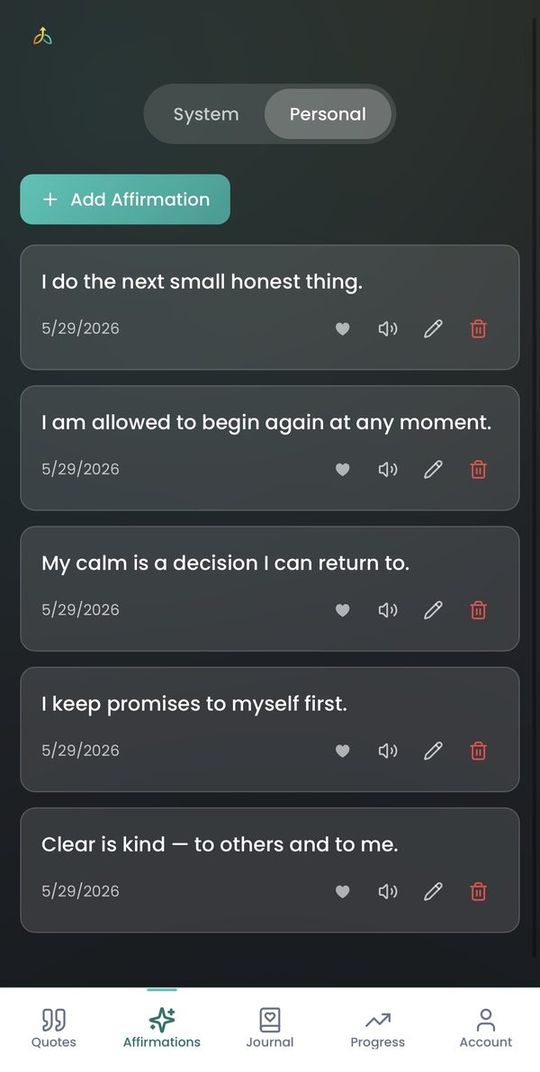
A personal affirmation is a short line you write for yourself and return to — a reminder of how you want to show up or what you want to practice. Built-in affirmations are a fine starting point, but the ones you write tend to carry more weight, because they sound like your life instead of a slogan. If you want the bigger picture first, start with what affirmations are; this guide is the how-to.
The most important rule is simple: write something you can accept as true. An affirmation you don't believe is just words you skip past. That doesn't mean it has to describe where you already are — "I'm practicing patience" works even on a day you lost it — but it does have to feel honest. If reading it back makes you roll your eyes, it's too big. Bring it down to something you'd actually say.
You don't need to invent the wording from scratch. A few openers do most of the work:
Generic lines fade; specific ones stick. Pull from what's actually in front of you — a challenge you're facing, a habit you're building, a reminder you keep forgetting. "I can handle hard conversations" is fine, but "I can say the honest thing in tomorrow's meeting" is something you'll reach for. Keep it short enough to remember and pointed enough to matter.
An affirmation only works if you return to it. Tie it to a moment you already have — the start of the day, a short pause, or the minutes before something hard. Pairing one with a daily reset is an easy way to make it part of the routine instead of a note you forget.
EVERLIFT gives you built-in affirmations for when you need a starting point and a place to write and save your own when you want words that sound like you. Both stay together, so the lines you want to practice are easy to find. New here? See what EVERLIFT is.
Download EVERLIFT on the App Store →
Start free and write your first personal affirmation today.
Start with what you need to remember, keep it honest, and use a simple opener like "I can," "I choose," or "I'm allowed to." If you don't believe it, make it smaller until you do.
That you actually believe it and return to it. Specific lines tied to your real week stick better than generic ones, and giving the affirmation a regular moment keeps it in use.
A few you'll actually use beats a long list you ignore. Keep the ones that fit what you're working on now, and update them as that changes.
Keep reading
What are affirmations? · How to build a daily reset routine · What is EVERLIFT?
New resources, app updates, and practical reset ideas. No spam.
By joining you'll get occasional EVERLIFT Updates. Unsubscribe anytime via any email. See our Privacy Policy.
 EVERLIFT